Preparation of activated carbons from coffee husk using KOH activation for phenol adsorption
Author affiliations
DOI:
https://doi.org/10.15625/2525-2518/18299Keywords:
coffee husk, activated carbon, surface area, phenol adsorption, isothermsAbstract
This study explores the development of activated carbons (ACs) synthesized from coffee husks using potassium hydroxide (KOH) as the activating agent under varying conditions, focusing on their potential for phenol adsorption. The effects of impregnation ratio, activation temperature, and activation time on the pore structure and surface chemistry of the resulting ACs were studied. Under optimal synthesis conditions, the sample ACK3-750-60, with a specific surface area of 1905 m2 g-1, a total pore volume of 0.8613 cm3 g-1, and numerous surface functional groups (2.35 mmol g-1acidic groups and 0.36 mmol g-1 basic groups), was obtained. The ACs have a predominantly microporous structure, as confirmed by iodine adsorption. The change in iodine number correlates with the pore texture obtained from BET measurements. Equilibrium sorption of phenol was studied and fitted by the Langmuir, Dubinin–Radushkevich, Elovich, and Temkin isotherms. The ACs achieved a maximum monolayer adsorption capacity of 199.20 mg g-1 at 30 °C, with an adsorption energy variation of 12.50 kJ mol-1.
Downloads
References
1. Panigrahy N., Priyadarshini A., Sahoo M. M., Verma A. K., Daverey A., Sahoo N. K. – A comprehensive review on eco-toxicity and biodegradation of phenolics: Recent progress and future outlook. Environ. Technol. Innov., 27 (2022) 102423. https://doi.org/10.1016/j.eti.2022.102423.
2. Grace Pavithra K., Sundar Rajan P., Arun J., Brindhadevi K., Hoang Le Q., Pugazhendhi A. – A review on recent advancements in extraction, removal and recovery of phenols from phenolic wastewater: Challenges and future outlook. Environ. Res., 237 (2023) 117005. https://doi.org/10.1016/j.envres.2023.117005.
3. Saputera W. H., Putrie A. S., Esmailpour A. A., Sasongko D., Suendo V., Mukti R. R. – Technology advances in phenol removals: Current progress and future perspectives. Catalysts, 11 (2021) 998. https://doi.org/10.3390/catal11080998.
4. Nam N. H., Ngoc C. T. A., Van Bay T. – Investigation on gasification of coffee husk in CO₂, H₂O, and mixed atmospheres. Vietnam J. Chem., 59 (2021) 775–780. https://doi.org/10.1002/vjch.202100002.
5. Thuy Luong Thi T., Ta H. S., Le Van K. – Activated carbons from coffee husk: Preparation, characterization, and reactive red 195 adsorption. J. Chem. Res., 45 (2020) 380–394. https://doi.org/10.1177/1747519820970469.
6. Siipola V., Tamminen T., Källi A., et al. – Effects of biomass type, carbonization process, and activation method on the properties of bio-based activated carbons. BioResources, 13 (2018) 5976–6002. https://doi.org/10.15376/biores.13.3.5976-6002.
7. Sharma G., Sharma S., Kumar A., et al. – Activated carbon as superadsorbent and sustainable material for diverse application. Adsorp. Sci. Technol., 2022 (2022) 4184809. https://doi.org/10.1155/2022/4184809.
8. Zhang Y., Zhao Y.-P., Qiu L.-L., et al. – Insights into the KOH activation parameters in the preparation of corncob-based microporous carbon for high-performance supercapacitors. Diamond Relat. Mater., 129 (2022) 109331. https://doi.org/10.1016/j.diamond.2022.109331.
9. Oginni O., Singh K., Oporto G., Dawson-Andoh B., McDonald L., Sabolsky E. – Influence of one-step and two-step KOH activation on activated carbon characteristics. Bioresour. Technol. Rep., 7 (2019) 100266. https://doi.org/10.1016/j.biteb.2019.100266.
10. Schönherr J., Buchheim J., Scholz P., Adelhelm P. – Boehm titration revisited (Part I): Practical aspects for achieving a high precision in quantifying oxygen-containing surface groups on carbon materials. C, 4 (2018) 21. https://doi.org/10.3390/c4020021.
11. Njewa J. B., Vunain E., Biswick T. – Synthesis and characterization of activated carbons prepared from agro-wastes by chemical activation. J. Chem., 2022 (2022) 1–13. https://doi.org/10.1155/2022/9975444.
12. Thongpat W., Taweekun J., Maliwan K. – Synthesis and characterization of microporous activated carbon from rubberwood by chemical activation with KOH. Carbon Lett., 31 (2021) 1079–1088. https://doi.org/10.1007/s42823-020-00224-z.
13. Guo Y., Wang Q. – Fabrication and characterization of activated carbon from Phyllostachys edulis using single-step KOH activation with different temperatures. Processes, 10 (2022) 1712. https://doi.org/10.3390/pr10091712.
14. Van H. T., Bui T. T. P., Nguyen L. H. – Residual organic compound removal from aqueous solution using commercial coconut shell activated carbon modified by a mixture of seven metal salts. Water Air Soil Pollut., 229 (2018) 292. https://doi.org/10.1007/s11270-018-3953-4.
15. Nandi R., Jha M. K., Guchhait S. K., Sutradhar D., Yadav S. – Impact of KOH activation on rice husk derived porous activated carbon for carbon capture at flue gas alike temperatures with high CO₂/N₂ selectivity. ACS Omega, 8 (2023) 4802–4812. https://doi.org/10.1021/acsomega.2c06955.
16. Liu P., Sun S., Huang S., et al. – KOH activation mechanism in the preparation of brewer’s spent grain-based activated carbons. Catalysts, 14 (2024) 814. https://doi.org/10.3390/catal14110814.
17. Zhang Y.-J., Xing Z.-J., Duan Z.-K., Li M., Wang Y. – Effects of steam activation on the pore structure and surface chemistry of activated carbon derived from bamboo waste. Appl. Surf. Sci., 315 (2014) 279–286. https://doi.org/10.1016/j.apsusc.2014.07.126.
18. Anisuzzaman S. M., Sinring N., Fran Mansa R. – Properties tuning of palm kernel shell biochar granular activated carbon using response surface methodology for removal of methylene blue. J. Appl. Sci. Process Eng., 8 (2021) 1002–1019. https://doi.org/10.33736/jaspe.3961.2021.
19. Ilić M., Haegel F.-H., Lolić A., et al. – Surface functional groups and degree of carbonization of selected chars from different processes and feedstock. PLoS One, 17 (2022) e0277365. https://doi.org/10.1371/journal.pone.0277365.
20. Angın D., Altintig E., Köse T. E. – Influence of process parameters on the surface and chemical properties of activated carbon obtained from biochar by chemical activation. Bioresour. Technol., 148 (2013) 542–549. https://doi.org/10.1016/j.biortech.2013.08.164.
21. de Souza C. C., de Souza L. Z. M., Yılmaz M., et al. – Activated carbon of Coriandrum sativum for adsorption of methylene blue: Equilibrium and kinetic modeling. Cleaner Mater., 3 (2022) 100052. https://doi.org/10.1016/j.clema.2022.100052.
22. Rocha R. P., Pereira M. F. R., Figueiredo J. L. – Characterisation of the surface chemistry of carbon materials by temperature-programmed desorption: An assessment. Catal. Today, 418 (2023) 114136. https://doi.org/10.1016/j.cattod.2023.114136.
23. Fairus M. J. M., Ibrahim M. F., Zainal N. H., Abd-Aziz S., Phang L.-Y. – Phenol adsorption performance by bamboo activated carbon produced using fabricated two-in-one carbonization activation pilot reactor. Environ. Technol. Innov., 40 (2025) 104427. https://doi.org/10.1016/j.eti.2025.104427.
24. Thummajitsakul S., Piyaphan P., Khamthong S., Unkam M., Silprasit K. – Comparison of PTIR fingerprint, phenolic content, antioxidant and anti-glucosidase activities among Phaseolus vulgaris L., Arachis hypogaea L. and Plukenetia volubilis L. Electron. J. Biotechnol., 61 (2023) 14–23. https://doi.org/10.1016/j.ejbt.2022.10.003.
25. Ayawei N., Ebelegi A. N., Wankasi D. – Modelling and interpretation of adsorption isotherms. J. Chem., 2017 (2017) 1–11. https://doi.org/10.1155/2017/3039817.
26. Salari M., Dehghani M. H., Azari A., Motevalli M. D., Shabanloo A., Ali I. – High performance removal of phenol from aqueous solution by magnetic chitosan based on response surface methodology and genetic algorithm. J. Mol. Liq., 285 (2019) 146–157. https://doi.org/10.1016/j.molliq.2019.04.065.
27. Duarte M., Nascimento G., Santos M., et al. – Adsorption of phenol on adsorbents produced from coconut tree waste: Kinetic and equilibrium studies. Environ. Eng. Manag. J., 18 (2019) 693–705. https://doi.org/10.30638/eemj.2019.063.
28. Lütke S. F., Igansi A. V., Pegoraro L., Dotto G. L., Pinto L. A. A., Cadaval T. R. S. – Preparation of activated carbon from black wattle bark waste and its application for phenol adsorption. J. Environ. Chem. Eng., 7 (2019) 103396. https://doi.org/10.1016/j.jece.2019.103396.
29. Lv S., Li C., Mi J., Meng H. – A functional activated carbon for efficient adsorption of phenol derived from pyrolysis of rice husk, KOH-activation and EDTA-4Na-modification. Appl. Surf. Sci., 510 (2020) 145425. https://doi.org/10.1016/j.apsusc.2020.145425.
30. Xie B., Qin J., Wang S., Li X., Sun H., Chen W. – Adsorption of phenol on commercial activated carbons: Modeling and interpretation. Int. J. Environ. Res. Public Health, 17 (2020) 789. https://doi.org/10.3390/ijerph17030789.
31. Lorenc-Grabowska E. – Effect of micropore size distribution on phenol adsorption on steam activated carbons. Adsorption, 22 (2015) 599–607. https://doi.org/10.1007/s10450-015-9737-x.
32. Hamdaoui O., Naffrechoux E. – Modeling of adsorption isotherms of phenol and chlorophenols onto granular activated carbon, Part I. Two-parameter models and equations allowing determination of thermodynamic parameters. J. Hazard. Mater., 147 (2007) 381–394. https://doi.org/10.1016/j.jhazmat.2007.01.021.
Downloads
Published
How to Cite
Issue
Section
License

This work is licensed under a Creative Commons Attribution-ShareAlike 4.0 International License.
Vietnam Journal of Sciences and Technology (VJST) is an open access and peer-reviewed journal. All academic publications could be made free to read and downloaded for everyone. In addition, articles are published under term of the Creative Commons Attribution-ShareAlike 4.0 International (CC BY-SA) Licence which permits use, distribution and reproduction in any medium, provided the original work is properly cited & ShareAlike terms followed.
Copyright on any research article published in VJST is retained by the respective author(s), without restrictions. Authors grant VAST Journals System a license to publish the article and identify itself as the original publisher. Upon author(s) by giving permission to VJST either via VJST journal portal or other channel to publish their research work in VJST agrees to all the terms and conditions of https://creativecommons.org/licenses/by-sa/4.0/ License and terms & condition set by VJST.
Authors have the responsibility of to secure all necessary copyright permissions for the use of 3rd-party materials in their manuscript.




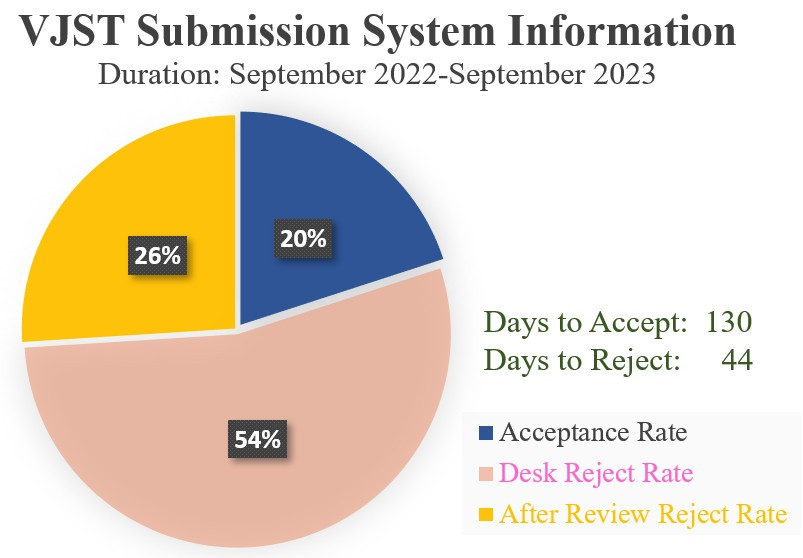
 Vietnam Journal of Science and Technology (VJST) is pleased to notice: