Technological factors influencing on production of pharmaceutical-grade carboxymethyl cellulose (CMC) from cotton cellulose
Author affiliations
DOI:
https://doi.org/10.15625/2525-2518/19579Keywords:
carboxymethyl cellulose, cotton cellulose, pharmaceutical gradeAbstract
The effects of sodium hydroxide (NaOH) concentration, molar ratios of monochloroacetic acid (MCA) to anhydroglucose unit (AGU), molar ratios of NaOH to MCA, ethanol concentration, and volume on carboxymethyl cellulose (CMC) production were investigated. The results demonstrated that CMC with an average substitution degree of 0.9267 was obtained using 50 % (w/v) NaOH, a MCA/AGU molar ratio of 1.3, and a NaOH/MCA molar ratio of 3. The optimal washing process for achieving pharmaceutical-grade carboxymethyl cellulose involved a series of five washes with 60 mL of 80 % v/v ethanol, resulting in impurity residue consisting of sodium chloride (NaCl) and sodium glycolate (HNa) at 0.23 % and 0.19 %, respectively. This process represented the least amount of solvent required to attain pharmacopoeial standards for CMC purity, while also minimizing the number of washes needed to preserve the quality of the CMC product. These results offered a practical method for preparing high-purity CMC for use in the pharmaceutical industry.
Downloads
References
1. Rowe R. C., Sheskey P. J., Owen S. C. – Handbook of pharmaceutical excipients, 5th edn, Pharmaceutical Press, London (2005).
2. Yeasmin Mst. S., Mondal Md. I. H. – Synthesis of highly substituted carboxymethyl cellulose depending on cellulose particle size. Int. J. Biol. Macromol., 80 (2015) 725–731. https://doi.org/10.1016/j.ijbiomac.2015.07.040.
3. Ciolacu D., Popa V. I. – Structural changes of cellulose determined by dissolution in aqueous alkali solution. Cellul. Chem. Technol., 39 (2005) 179–188.
4. Shui T., Feng S., Chen G., et al. – Synthesis of sodium carboxymethyl cellulose using bleached crude cellulose fractionated from cornstalk. Biomass Bioenergy, 105 (2017) 51–58. https://doi.org/10.1016/j.biombioe.2017.06.016.
5. Panchan N., Wattanapan P., Sungsinchai S., et al. – Optimization of synthesis conditions for carboxymethyl cellulose from pineapple leaf waste using microwave-assisted heating and its application as a food thickener. BioResources, 16 (2021) 7684–7701. https://doi.org/10.15376/16.4.7684-7701.
6. Jia F., Liu H., Zhang G. – Preparation of carboxymethyl cellulose from corncob. Procedia Environ. Sci., 31 (2016) 98–102. https://doi.org/10.1016/j.proenv.2016.02.013.
7. Celikçi N., Ziba C. A., Dolaz M. – Synthesis and characterization of carboxymethyl cellulose (CMC) from different waste sources containing cellulose and investigation of its use in the construction industry. Cellul. Chem. Technol., 56 (2021) 55–68. https://doi.org/10.35812/cellulosechemtechnol.2022.56.05.
8. Yanli W., Wenyuan G., Xia L. – Carboxymethyl Chinese yam starch: synthesis, characterization, and influence of reaction parameters. Carbohydr. Res., 344 (2009) 1764–1769. https://doi.org/10.1016/j.carres.2009.06.014.
9. Nguyen T. D. P., Le N. T., Vu T. M., et al. – Synthesis and characterization of carboxymethyl cellulose with high degree substitution from Vietnamese pineapple leaf waste. Vietnam J. Sci. Technol. Eng., 64 (2022) 13–18. https://doi.org/10.31276/vjste.64(3).13-18.
10. Singh R. K., Singh A. K. – Optimization of reaction conditions for preparing carboxymethyl cellulose from corn cobic agricultural waste. Waste Biomass Valorization, 4 (2013) 129–137. https://doi.org/10.1007/s12649-012-9123-9.
11. Yokota H. – The mechanism of cellulose alkalization in the isopropyl alcohol-water-sodium hydroxide-cellulose system. J. Appl. Polym. Sci., 30 (1985) 263–277. https://doi.org/10.1002/app.1985.070300121.
12. Stigsson V., Kloow G., Germgård U. – The influence of the solvent system used during manufacturing of CMC. Cellulose, 13 (2006) 705–712. https://doi.org/10.1007/s10570-006-9083-y.
13. Gordon S., Hsieh Y.-L. – Cotton: Science and technology, Woodhead Publishing Limited, United Kingdom (2007). https://doi.org/10.1533/9781845692483.
14. Haleem N., Arshad M., Shahid M., Tahir M. A. – Synthesis of carboxymethyl cellulose from waste of cotton ginning industry. Carbohydr. Polym., 113 (2014) 249–255. https://doi.org/10.1016/j.carbpol.2014.07.023.
15. Rahaman Md. S., Nahar S. S., Islam J. M. M., et al. – Utilization of waste textile cotton by synthesizing sodium carboxymethyl cellulose: an approach to minimize textile solid waste. Adv. Polym. Technol., 2022 (2022) 1–10. https://doi.org/10.1155/2022/4255409.
16. Abdullaevich Y. S., Ergashovich Y. K., Abdukhalilovich S. A., Shavkat o’g’li G. I. – Synthesis and characterization of sodium-carboxymethylcellulose from cotton, powder, microcrystalline and nanocellulose. Polym. Eng. Sci., 62 (2021) 677–686. https://doi.org/10.1002/pen.25874.
17. ASTM D1439-22 – Standard test methods for sodium carboxymethylcellulose, ASTM International (2022). https://doi.org/10.1520/d1439-22.
18. Yuldoshov S., Sarymsakov K. – Purified carboxymethyl cellulose for the pharmaceutical industry. Int. J. Adv. Sci. Technol., 29 (2020) 4733–4737.
Downloads
Published
How to Cite
Issue
Section
License

This work is licensed under a Creative Commons Attribution-ShareAlike 4.0 International License.
Vietnam Journal of Sciences and Technology (VJST) is an open access and peer-reviewed journal. All academic publications could be made free to read and downloaded for everyone. In addition, articles are published under term of the Creative Commons Attribution-ShareAlike 4.0 International (CC BY-SA) Licence which permits use, distribution and reproduction in any medium, provided the original work is properly cited & ShareAlike terms followed.
Copyright on any research article published in VJST is retained by the respective author(s), without restrictions. Authors grant VAST Journals System a license to publish the article and identify itself as the original publisher. Upon author(s) by giving permission to VJST either via VJST journal portal or other channel to publish their research work in VJST agrees to all the terms and conditions of https://creativecommons.org/licenses/by-sa/4.0/ License and terms & condition set by VJST.
Authors have the responsibility of to secure all necessary copyright permissions for the use of 3rd-party materials in their manuscript.




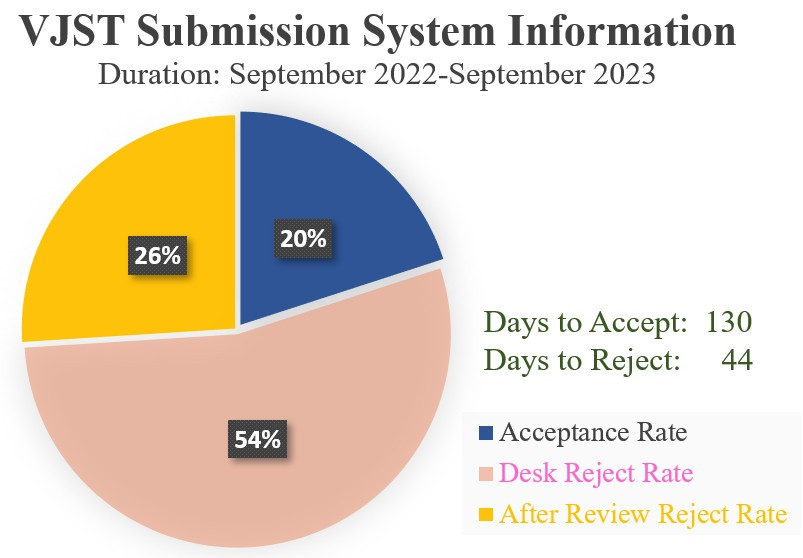
 Vietnam Journal of Science and Technology (VJST) is pleased to notice: