In silico and in vitro investigation of curcuminoid as potential TLR4/MD-2 complex inhibitors using molecular docking and molecular dynamic simulations
Author affiliations
DOI:
https://doi.org/10.15625/2525-2518/24045Keywords:
curcuminoid, antiflammatory, molecular docking, molecular dynamic, TLR4/MD-2Abstract
Inflammation is a key pathological process in many chronic diseases, in which the Toll-like receptor 4/myeloid differentiation factor-2 (TLR4/MD-2) complex serves as a critical upstream regulator. Curcuminoids, naturally occurring polyphenols abundant in Curcuma species cultivated in Vietnam, possess well-documented anti-inflammatory properties; however, their molecular interactions with TLR4/MD-2 remain poorly understood. In this study, an integrated in silico and in vitro strategy was employed to evaluate the anti-inflammatory potential of three major curcuminoids: curcumin, demethoxycurcumin, and bisdemethoxycurcumin. Molecular docking indicated that curcumin and bisdemethoxycurcumin exhibited strong binding affinities toward the TLR4/MD-2 complex, with docking scores of -9.29 and -9.73 kcal/mol, respectively. Molecular dynamics simulations further confirmed the structural stability of these complexes and revealed persistent key interactions. ADMET predictions suggested favorable drug-likeness and low toxicity profiles. Consistently, in vitro assays using LPS-stimulated RAW 264.7 macrophages demonstrated that curcumin and bisdemethoxycurcumin significantly inhibited nitric oxide production, with IC50 values of 121.06 ± 2.16 µM and 91.22 ± 1.58 µM, whereas demethoxycurcumin showed negligible activity. Overall, curcumin and bisdemethoxycurcumin emerge as promising natural compounds for the development of TLR4/MD-2-targeted anti-inflammatory agents.
Downloads
References
1. Nguyen T. T. T., Tran V. A., Tran T. H., Ho V. D., Do T. H., Truong Q. K., Pham M. Q., Le T. H. V. - Megastigmanes isolated from Boehmeria nivea leaves and their immunomodulatory effect on IL-1β and IL-10 production in RAW264.7 macrophages. RSC Adv., 15(15) (2025) 11549-11561. https://doi.org/10.1039/d4ra06545j.
2. Rahman S. U., Li Y., Huang Y., Zhu L., Feng S., Wu J., Wang X. - Treatment of inflammatory bowel disease via green tea polyphenols: possible application and protective approaches. Inflammopharmacology, 26(2) (2018) 319-330. https://doi.org/10.1007/s10787-018-0462-4.
3. Hsu C. L., Fang S. C., Yen G. C. - Anti-inflammatory effects of phenolic compounds isolated from the flowers of Nymphaea mexicana Zucc. Food Funct., 4(8) (2013) 1216-1222. https://doi.org/10.1039/c3fo60041f.
4. Bauer M. E., Teixeira A. L. - Inflammation in psychiatric disorders: what comes first? Ann. N.Y. Acad. Sci., 1437(1) (2018) 57-67. https://doi.org/10.1111/nyas.13712.
5. Balahura Stamat L. R., Dinescu S. - Inhibition of NLRP3 inflammasome contributes to paclitaxel efficacy in triple negative breast cancer treatment. Sci. Rep., 14(1) (2024) 24753. https://doi.org/10.1038/s41598-024-75805-3.
6. Sharma S., Kumar D., Singh G., Monga V., Kumar B. - Recent advancements in the development of heterocyclic anti-inflammatory agents. Eur. J. Med. Chem., 200 (2020) 112438. https://doi.org/10.1016/j.ejmech.2020.112438.
7. Bian M., Ma Q. Q., Wu Y., Du H. H., Guo-Hua G. - Small molecule compounds with good anti-inflammatory activity reported in the literature from 01/2009 to 05/2021: a review. J. Enzyme Inhib. Med. Chem., 36(1) (2021) 2139-2159. https://doi.org/10.1080/14756366.2021.1984903.
8. Kasetsuwan N., Reinprayoon U., Uthaithammarat L., Sereemaspun A., Sae-Liang N., Chaichompoo W., Suksamrarn A. - Anti-inflammatory effect of curcuminoids and their analogs in hyperosmotic human corneal limbus epithelial cells. BMC Complement Med Ther, 24(1) (2024) 172. https://doi.org/10.1186/s12906-024-04448-8.
9. Sandur S. K., Pandey M. K., Sung B., Ahn K. S., Murakami A., Sethi G., Limtrakul P., Badmaev V., Aggarwal B. B. - Curcumin, demethoxycurcumin, bisdemethoxycurcumin, tetrahydrocurcumin and turmerones differentially regulate anti-inflammatory and anti-proliferative responses through a ROS-independent mechanism. Carcinogenesis, 28(8) (2007) 1765-1773. https://doi.org/10.1093/carcin/bgm123.
10. Schrodinger L. L. C. - The PyMOL Molecular Graphics System, Version 1.3r1.(2010).
11. Allouche A. R. - Gabedit-A graphical user interface for computational chemistry softwares. J. Comput. Chem., 32(1) (2011) 174-182. https://doi.org/10.1002/jcc.21600.
12. Morris G. M., Huey R., Lindstrom W., Sanner M. F., Belew R. K., Goodsell D. S., Olson A. J. - AutoDock4 and AutoDockTools4: Automated docking with selective receptor flexibility. J. Comput. Chem., 30(16) (2009) 2785-2791. https://doi.org/10.1002/jcc.21256.
13. Molinspiration Cheminformatics FreeWeb Services - Slovensky Grob, Slovakia. https://www.molinspiration.com/cgi-bin/properties (accessed 16 December 2025).
14. Cheng F., Li W., Zhou Y., Shen J., Wu Z., Liu G., Lee P. W., Tang Y. - admetSAR: A comprehensive source and free tool for assessment of chemical ADMET properties. J. Chem. Inf. Model., 52(11) (2012) 3099-3105. https://doi.org/10.1021/ci300367a.
15. Cheenpracha S., Park E. J., Rostama B., Pezzuto J. M., Chang L. C. - Inhibition of Nitric oxide (NO) production in lipopolysaccharide (LPS)-Activated murine macrophage RAW 264.7 cells by the norsesterterpene peroxide, epimuqubilin A. Mar. Drugs, 8(3) (2010) 429-437. https://doi.org/10.3390/md8030429.
16. Lipinski C. A. - Drug-like properties and the causes of poor solubility and poor permeability. J. Pharmacol Toxicol Methods, 44(1) (2000) 235-249. https://doi.org/10.1016/s1056-8719(00)00107-6.
Downloads
Published
How to Cite
Issue
Section
License

This work is licensed under a Creative Commons Attribution-ShareAlike 4.0 International License.
Vietnam Journal of Sciences and Technology (VJST) is an open access and peer-reviewed journal. All academic publications could be made free to read and downloaded for everyone. In addition, articles are published under term of the Creative Commons Attribution-ShareAlike 4.0 International (CC BY-SA) Licence which permits use, distribution and reproduction in any medium, provided the original work is properly cited & ShareAlike terms followed.
Copyright on any research article published in VJST is retained by the respective author(s), without restrictions. Authors grant VAST Journals System a license to publish the article and identify itself as the original publisher. Upon author(s) by giving permission to VJST either via VJST journal portal or other channel to publish their research work in VJST agrees to all the terms and conditions of https://creativecommons.org/licenses/by-sa/4.0/ License and terms & condition set by VJST.
Authors have the responsibility of to secure all necessary copyright permissions for the use of 3rd-party materials in their manuscript.




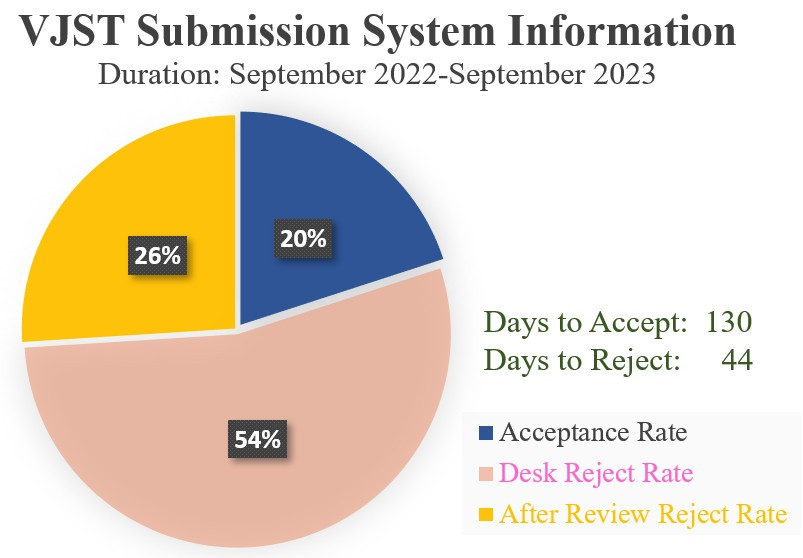
 Vietnam Journal of Science and Technology (VJST) is pleased to notice: